
Key takeaways
- Citations typically take three to five years to build up meaningfully, too slow to say much about how an article is landing in its first year.
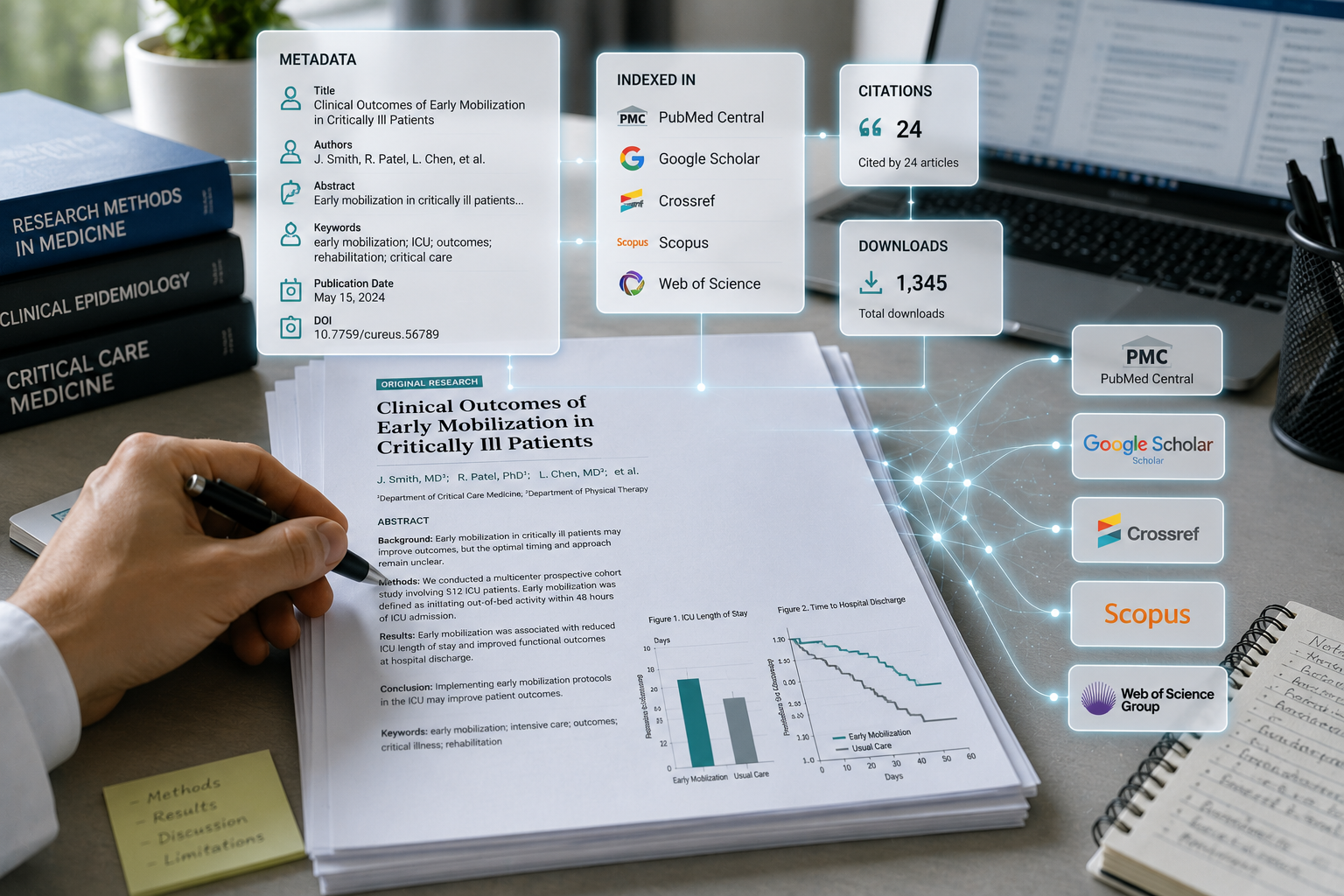
- Article-level metrics combine citations, downloads, and altmetrics (social media mentions, news coverage, and policy citations) into a fuller picture of an article's reach.
- Altmetric-style tools track attention across news outlets, social platforms, blogs, and policy documents, not just academic citations.
- The Declaration on Research Assessment (DORA) specifically discourages leaning on a single number, like the Journal Impact Factor, to judge an individual article.
- Cureus's Altmetric badges and Scholarly Impact Quotient (SIQ) give authors two article-level signals beyond the traditional citation count.

Recent bibliometric research puts the average citation lag at three to five years, too slow to reveal much about an article's reach in its first year or two. Article-level metrics fill in what citation counts miss: instead of waiting on citations alone, they track downloads, reads, social shares, news coverage, and other signs that people are engaging with a piece of research right now.
This piece looks at what these metrics actually measure, how researchers and institutions use them, and why most experts now argue that no single number tells the whole story.
What citation counts miss
Citation counts have an obvious appeal: they're standardized, comparable across databases, and easy to track. Unfortunately, they also miss a lot. A article on a fast-moving topic can be read, downloaded, and applied in practice long before it accumulates enough citations to register.
A mathematics article and a biomedical article rarely earn citations at comparable rates, so comparing the two on citation count alone doesn't tell you much. Tools like the Relative Citation Ratio try to correct for this by weighing an article against others in its own field rather than the literature at large; even then, it's still counting citations, just a narrower set of them.
Policymakers, clinicians, and journalists rarely show up in a reference list, even when they act on the research directly. A citation count has nothing to say about any of them.
What article-level metrics actually track

Downloads and reads
Downloads and views show up almost immediately after publication, long before a single citation does. Editors and authors treat that as the earliest signal that an article is landing with anyone at all.
 Altmetric-style indicators
The term “altmetrics” is short for “alternative metrics.” These tools track attention outside the citation graph entirely: mentions in news outlets, posts on social platforms, references in policy documents, entries on Wikipedia, and discussion on sites like Reddit. Cureus makes this visible directly on the article page. A colored badge shows an “Attention Score,” and clicking through reveals exactly where an article has been picked up.
Post-publication engagement
Comments, ratings, and shares reflect what the research community thinks of an article once it's out in the world, independent of whether other researchers eventually cite it. Cureus's own Scholarly Impact Quotient (SIQ) works this way: registered readers rate a published article on clarity, study design, and similar categories, a second opinion that never touches peer review.
Why researchers are paying attention
An article that reaches clinicians, informs a policy document, or gets picked up by a mainstream outlet has done something a citation count won't show for another year or two. Funders and hiring committees have started weighing what a citation count misses, wanting more from a CV than a citation count alone.
Open access metrics show the same dynamic: freely available articles see measurably higher download and share counts than paywalled articles in the same field. There's no paywall standing between the work and the journalists, clinicians, and members of the public who might otherwise never see it.

An article picked up by a policy brief, shared across physician social media, and downloaded a thousand times in its first month has already reached people, well before a citation count would notice. Research dissemination measures exactly that kind of reach: how far a piece of work travels after it leaves the journal, through the channels that scholarly communication increasingly uses but that a citation count was never built to measure.
Does an article nobody reads still count as high-reach research? Funders increasingly say no. A technically sound article that never gets read, shared, or picked up outside its own journal still has limited scientific impact, no matter how solid the underlying work is. That's part of why institutions are folding research impact metrics into how they evaluate applicants, alongside traditional citation counts.
Self-citation rings can inflate a citation count without much scholarly interest behind them. A single viral post or a well-placed press release can do the same for an altmetric score. Neither trick works as well across several article-level metrics at once: a signal tends to show up in more than one place.
Why no single metric tells the whole story
The Declaration on Research Assessment, known as DORA, recommends against using journal-based metrics, including the Journal Impact Factor, as a stand-in for the quality of an individual article or the researcher behind it. A journal-level average says very little about one specific article, and it says nothing at all about who is actually reading it.
 Cureus, a DORA signatory, takes the same approach. Reads, citations, and its own Scholarly Impact Quotient (SIQ) sit side by side rather than rolling up into one score. Most researchers already think about impact this way: several partial views, not one number.
Publish your research with Cureus
If you want your work to achieve more than a citation count, Cureus is built around open access, so published research is available to readers everywhere at no cost. Research visibility starts the moment an article is published: it carries an Altmetric badge and starts gathering SIQ ratings right away, and Cureus's Collections feature lets guest editors group related articles by topic for readers browsing a specific field.
Review the publishing process and peer review guidelines when you are ready to submit, or read and rate a few published articles to see how these metrics work in practice before your own article goes live.
For a broader look at where the field is headed, see our roundup of medical research publishing trends.
Frequently asked questions
Q: What's the difference between article-level metrics and a journal's Impact Factor?
A: A Journal Impact Factor measures a journal's average citation rate across all of its articles over a set window, usually two years. Article-level metrics measure a single article, combining citations with things like downloads, altmetric mentions, and reader ratings, so a strong article in a lower-profile journal can still show clear signs of reach.
Q: How long does it take for an article to build up a meaningful citation count?
A: Usually three to five years. The three-to-five-year lag is a big part of why researchers lean on other article-level metrics, especially in the first year or two after publication.
Q: What do altmetrics actually track?
A: Altmetrics track attention outside the citation graph: mentions in news coverage, social media posts, policy documents, blogs, Wikipedia entries, and similar sources. They are a read on visibility and dissemination, not academic influence specifically.
Q: Why do organizations like DORA discourage relying on a single metric?
A: No single number, including the Journal Impact Factor, captures everything that matters about an article: how many people read it, who acted on it, or how it holds up over time. DORA encourages looking at multiple article-level indicators together and asks institutions to say explicitly which indicators they use in hiring and funding decisions.


Join the discussion
Add your email, first name, and last name to leave a comment.