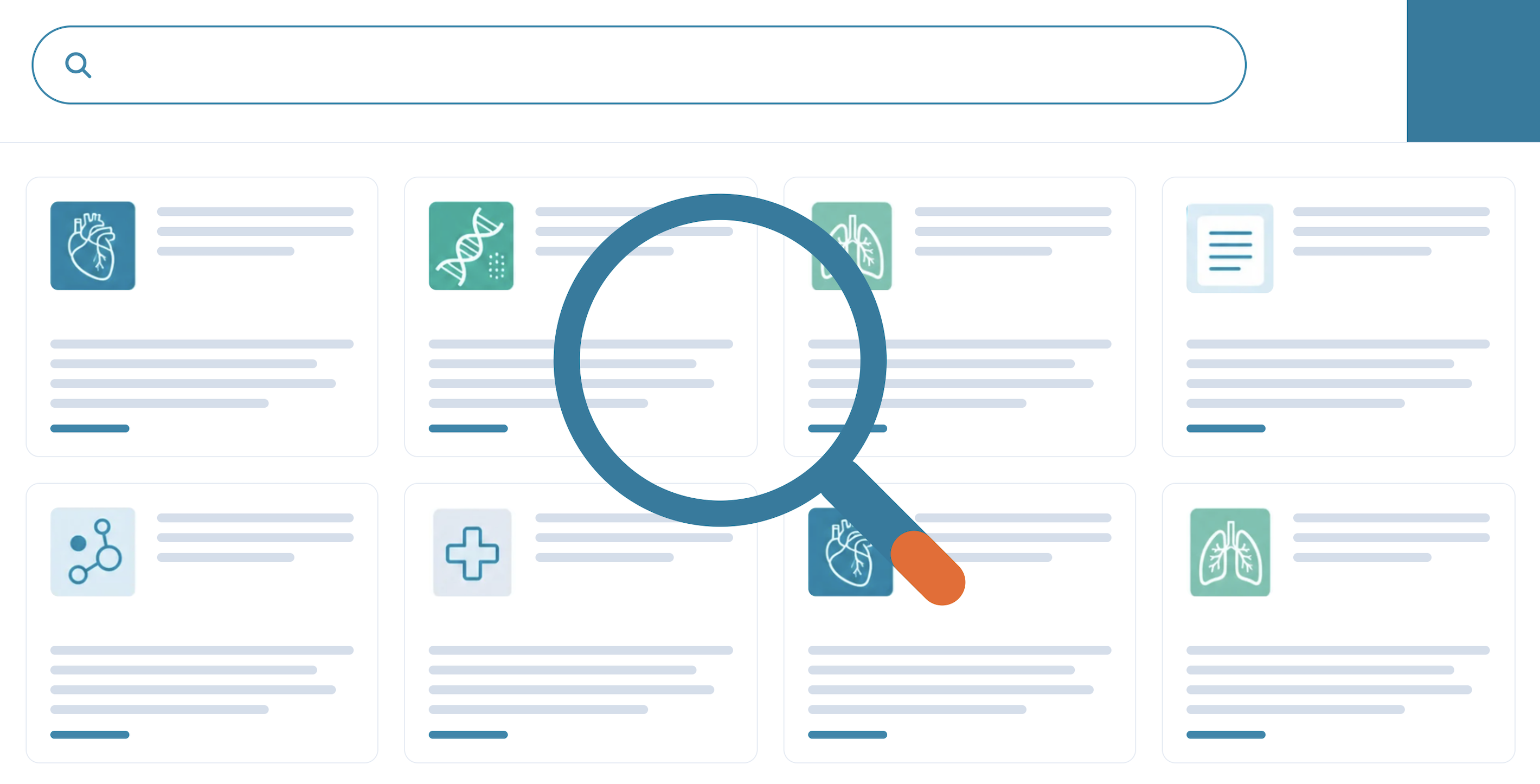

With more than 111,000 peer-reviewed articles published and counting, the Cureus Journal of Medical Science library grows every single day. The good news: you don't have to scroll endlessly to find what matters to you. The Browse Articles page gives you eight distinct ways to search, filter, and sort — whether you're a new reader exploring the journal for the first time or a clinician running a focused literature search.
Here's the short version: you can search by keyword, title, or author; filter by article type and medical specialty; sort by date or SIQ™; narrow by publication date; and discover content through curated keywords, top authors, and popular articles. Below, we break down each method and when to use it.
1. Search by keyword, title, or author
The fastest route to a specific paper is the search bar at the top of the Browse Articles page. Type in a keyword, a phrase from the title, or an author's name, and Cureus returns results ordered by relevance. This is the best starting point when you already know roughly what you're looking for: a topic, a study you half-remember, or the work of a particular researcher.
2. Filter by article type
Not every search calls for the same kind of paper. Cureus lets you filter by five article types:
- Original Article: primary research and original studies
- Review Article: syntheses of existing literature
- Case Report: detailed accounts of individual clinical cases
- Technical Report: methods, techniques, and procedural write-ups
- Editorial: commentary and perspective pieces
If you only want case reports in a given area, or you're surveying review articles before starting your own, this filter cuts the noise immediately.
3. Filter by medical specialty
Cureus organizes its content across more than 60 specialties, from Allergy/Immunology and Cardiology to Neurosurgery, Oncology, Radiology, and Urology. Use the Categories filter on the Browse Articles page to focus on your field, or visit the dedicated Specialties hub, where each specialty has its own landing page collecting the latest work in that area.
4. Sort by date or SIQ
Two sort options change what rises to the top of your results:
- Date surfaces the newest articles first, ideal for staying current.
- SIQ (Scholarly Impact Quotient) ranks articles by Cureus's crowd-sourced, post-publication quality rating. Sorting by SIQ helps you find the work the community has judged most impactful.
5. Narrow by publication date
Need only the most recent literature, or research from a specific window? The date filter lets you restrict results to a chosen time range, so you can exclude older material when recency matters for your review or citation.
6. Explore through relevant keywords
The Browse Articles page surfaces a set of trending and relevant keywords, topics like Artificial Intelligence, Obesity, Medical Education, Immunohistochemistry, and Diabetes. Clicking one is a fast way to discover active areas of research and jump into a focused cluster of articles without typing a single query.
7. Discover through top authors and popular articles
Two discovery routes help you find quality content by reputation rather than search terms. The Top Authors panel highlights researchers based on recent article SIQ ratings, while the dedicated Most Popular Articles page ranks the pieces currently drawing the most attention across the journal. Both are great for browsing when you're open to discovery rather than hunting for something specific.
8. Adjust how many results you see
A small but useful control: the Show 20 option lets you change how many articles appear per page. Increase it to scan more results at once, or keep it compact for quicker page loads.
Beyond: other ways to explore Cureus
Articles are just one content type. From the main navigation you can also browse:
- Posters and Abstracts: shorter-format research
- Collections: curated groupings of related articles
- Channels: academic and commercial channels that organize content by institution or partner
- Newsroom and Cureus U: highlighted articles and editorial roundups by specialty
International readers can also explore Cureus China and Cureus Japan.
Frequently asked questions
Q: How do I find articles on a specific medical specialty in Cureus?
A: Use the Categories filter on the Browse Articles page, or visit the Specialties hub and select your field. Cureus organizes content across more than 60 medical specialties, from Allergy/Immunology to Urology, and each one has its own dedicated page collecting the latest peer-reviewed articles in that area.
Q: What is SIQ on Cureus?
SIQ, or Scholarly Impact Quotient, is Cureus's crowd-sourced, post-publication rating system. Rather than relying only on editorial judgment, Cureus lets readers score published articles across several categories, and the resulting rating reflects how the community evaluates an article's quality and impact. Sort search results by SIQ to surface the highest-rated work.
Q: Can I search Cureus by author name?
A: Yes. Enter the author's name in the search bar at the top of the Browse Articles page, the same box used for keyword and title searches, and Cureus returns that author's published work ordered by relevance. This works well when you already know a specific researcher whose work you want to follow or cite.
Q: How do I find the newest articles on Cureus?
A: Sort the Browse Articles results by Date to surface the newest publications first, or apply the date-range filter to restrict results to a specific window, such as the past month or year. This is useful when recency matters for a literature review, a citation, or simply staying current in a specialty.
Q: What types of articles does Cureus publish?
A: Cureus publishes five article types: Original Articles (primary research), Review Articles (syntheses of existing literature), Case Reports (individual clinical cases), Technical Reports (methods and procedures), and Editorials (commentary and perspective). Use the Article Type filter on the Browse Articles page to isolate any one of these.
*This post was drafted with AI assistance and edited by our team before publishing.

.png)
Join the discussion
Add your email, first name, and last name to leave a comment.