
Key Takeaways
- Most published research on AI triage systems remains observational, with controlled trials evaluating real-world effectiveness still uncommon.
- Trauma care research increasingly relies on large registries to identify patterns across many hospitals rather than single-site studies.
- Predictive analytics in healthcare shows promise for early deterioration detection, but broader validation across diverse patient groups is still needed.
- Clinical decision support tools tend to succeed or fail based on workflow fit as much as on algorithm accuracy.
- Prehospital triage research faces distinct evidence gaps since field conditions are harder to standardize than in-hospital settings.

Emergency medicine is one of the fastest-changing areas of clinical research, and much of that change is being driven by data. From triage algorithms to trauma registries, emergency medicine research is increasingly focused on how tools built from large datasets perform under real-world pressure.
For researchers and reviewers alike, understanding where the evidence is strong and where it is still thin matters as much as understanding the tools themselves.
AI triage systems are a growing research focus
Where the evidence currently stands
Research into algorithmic triage has expanded quickly over the past several years, as hospitals look for ways to speed up decisions in crowded departments. Much of the current evidence comes from retrospective analyses rather than prospective trials, which limits how confidently findings can be generalized.
A scoping review published in Cureus on AI in emergency department triage found that machine learning models often outperformed conventional triage systems on discrimination measures, though few studies used randomized designs.
A widening evaluation gap
This pattern is common across emergency medicine AI research more broadly. The American College of Emergency Physicians’ AI Subcommittee has noted that AI tools are being applied across several areas of ED operations, including:
- Triage prioritization
- Risk prediction
- Staffing forecasts
- Imaging interpretation
Rigorous outcome-based evaluation still lags behind this adoption. As it accelerates faster than the evidence base, closing this gap remains a priority for emergency medicine research focused on AI triage systems specifically.
Trauma care research is shifting toward systems-level data
Why registries anchor modern trauma research
Much of today's trauma management research depends on large, standardized registries rather than individual case series. The National Trauma Data Bank, maintained by the American College of Surgeons, is one of the largest of these resources.
It allows researchers to compare outcomes and injury patterns across hundreds of trauma centers. This expanding body of trauma care research depends on consistent data quality across every contributing center.
The limits registries still carry
This registry-based approach has advantages, since it captures far more cases than any single hospital could, but it also introduces its own limits. Documentation quality varies between sites, which means trauma care research built on registry data still needs careful attention to how outcomes are defined and recorded.
Prehospital triage research faces its own evidence gaps
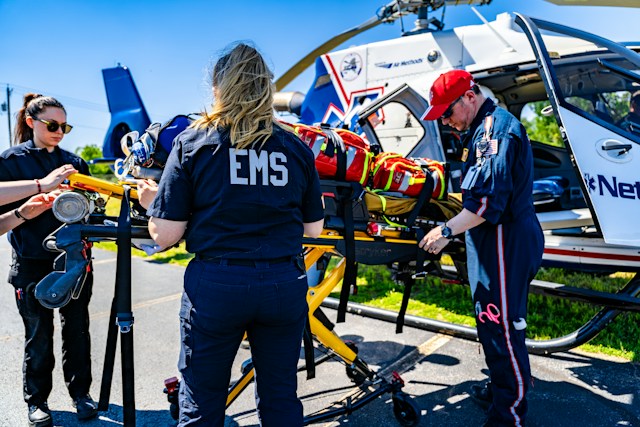
Research conducted before a patient ever reaches a hospital presents challenges that in-hospital studies do not face. Field conditions vary widely, and outcome data can be harder to track once a patient is handed off between agencies.
The National Association of EMS Physicians has highlighted these gaps directly, noting that much prehospital evidence still comes from position statements and expert consensus rather than large controlled studies. Closing this gap is important for emergency medicine research as a whole, since prehospital decisions often shape the outcomes that hospital-based studies later measure.
Clinical decision support tools depend on workflow fit
Accuracy isn’t the whole story
A well-validated algorithm does not guarantee a useful tool. Clinical informatics research consistently finds that clinical decision support tools succeed or fail based on how well they integrate into existing workflows, not solely on their underlying statistical performance.
What AHRQ’s research has found
The Agency for Healthcare Research and Quality's Digital Healthcare Research Program has funded multiple studies examining exactly this question, including how decision support interacts with triage and department overcrowding.
Their research suggests that tools built without frontline clinician input are more likely to be ignored, regardless of accuracy. This pattern surfaces throughout emergency medicine research, not only in decision support studies specifically.
Predictive analytics in healthcare needs broader validation
Where predictive models are being applied
Predictive models have generated substantial research interest for use cases such as:
- Patient deterioration
- Sepsis risk
- Resource and staffing needs
Validation across different hospitals and patient populations remains inconsistent. A model trained on one health system's data does not always perform the same way elsewhere, and this variability affects AI triage systems and other predictive tools alike.
How regulators are responding
The FDA's framework for AI-enabled medical devices now calls for real-world performance monitoring after deployment. This reflects a broader recognition that predictive analytics in healthcare needs ongoing evaluation, not a single validation study.
Emergency department research is expanding beyond the bedside

Emergency care innovation increasingly looks at operational questions alongside clinical outcomes, including:
- Staffing models
- Patient flow
- Overcrowding
A review published in Cureus on emergency department performance strategies found effects that varied in strength across studies. Advanced triage protocols and telemedicine were linked to shorter wait times, while dynamic staffing was tied to broader gains in operational efficiency and care quality.
This kind of emergency medicine research tends to be harder to standardize than single-intervention clinical studies since so many factors affect department performance at once. That complexity is itself part of the evidence gap researchers are working to address.
Where the evidence gaps point to future research
Recurring research priorities
Across triage, trauma, and decision support, a consistent pattern emerges: promising early results followed by a need for larger, more diverse, and more rigorously designed studies. The priorities that come up repeatedly include:
- Prospective trials
- Standardized outcome reporting
- Multi-site validation
These same gaps appear across AI triage systems, trauma registries, and decision-support studies alike, which is why emergency medicine research increasingly calls for prospective, multi-site trials.
The role of transparent reporting
Transparent reporting also plays a direct role in closing these gaps. Clear documentation of methods and limitations, consistent with research integrity standards, makes it easier for future researchers to build on existing work rather than repeat it.
How Cureus supports emergency medicine research
Cureus publishes a wide range of open access emergency medicine research spanning triage, trauma systems, and clinical informatics, alongside specialty-specific collections across emergency medicine and related fields.
Readers looking to follow a specific research theme can also explore curated collections, which group related studies together, making it easier to track how a research question develops across multiple publications over time.
Read emergency medicine research on Cureus
Cureus continues to publish new emergency medicine research, including studies on AI triage, trauma systems, and clinical decision support like the ones referenced throughout this piece. Reading, rating, and discussing this research also earns recognition through Cureus Honors, which rewards active engagement with published work.
Join Cureus today to contribute your own emergency medicine research.
Frequently asked questions
Q: What is the current state of emergency medicine research on AI triage?
A: Most current emergency medicine research on AI triage systems relies on retrospective data rather than randomized trials. Early findings are often positive, but researchers widely agree that more prospective, multi-site studies are needed before broad conclusions can be drawn.
Q: Why does trauma care research rely so heavily on registries?
A: Trauma care research uses registries like the National Trauma Data Bank because trauma cases are relatively rare at any single hospital. Pooling data across many centers gives researchers enough cases to detect meaningful patterns in outcomes and injury trends.
Q: What makes prehospital triage research different from in-hospital studies?
A: Prehospital triage research deals with less controlled environments, inconsistent documentation, and handoffs between agencies. These factors make large, standardized studies harder to conduct than similar research inside a hospital setting.
Q: Do clinical decision support tools need clinical trials to be useful?
A: Trials help establish accuracy, but research shows clinical decision support tools also need real-world workflow studies. A tool can be statistically sound and still fail in practice if it does not fit how clinicians actually work.
Q: Why is predictive analytics in healthcare hard to validate across hospitals?
A: Predictive analytics in healthcare often relies on patterns learned from one hospital's data, which may not transfer well to a different patient population, staffing model, or documentation style, making cross-site validation an ongoing research priority.


Join the discussion
Add your email, first name, and last name to leave a comment.